
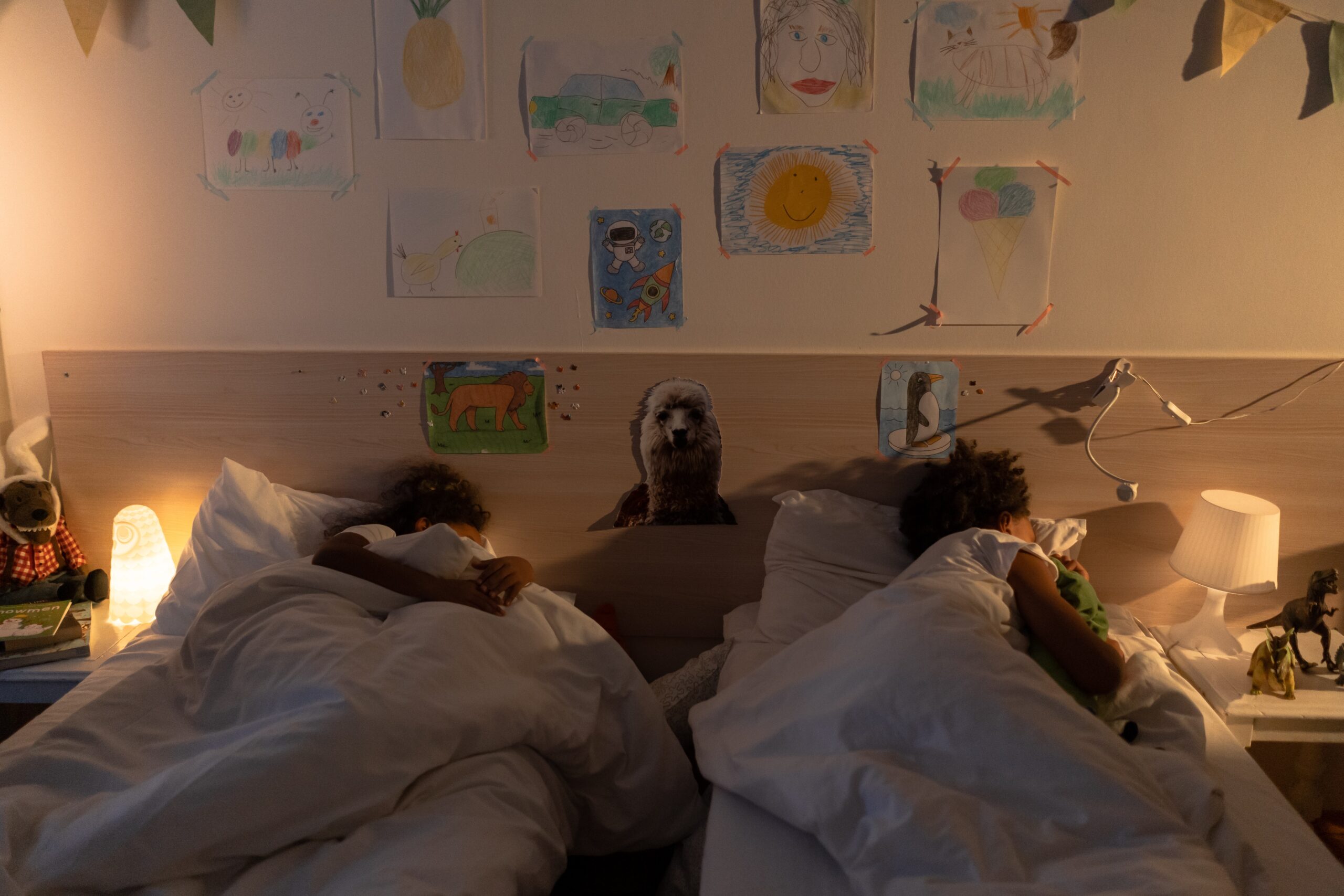
It is very common for autistic children to have unusual sleep patterns. If they are twins, triplets or quadruplets, this may lead to even more challenges.
Sleep troubles and autism
Sleep troubles and autism are very common – in fact it is estimated that up to 80% of autistic children have trouble sleeping. They may have trouble falling asleep, trouble staying asleep, poor sleep quality and waking too early. This can be due to a variety of things, such as problems with producing and releasing melatonin correctly, sensory processing disorder, restrictive diets or anxiety.
Autistic children frequently experience sleep difficulties due to a combination of biological and environmental factors. One primary biological contributor is the common prevalence of atypical melatonin regulation in autistic individuals. Melatonin, the hormone that regulates the sleep-wake cycle, may be produced at lower levels or at incorrect times, disrupting the natural circadian rhythm and making it harder for the child to feel sleepy when it’s bedtime. Another challenge is increased sensory sensitivities, such as a child’s hypersensitivity to sound, light, or touch may make the typical bedroom environment overwhelming. Even minor stimuli, like a ticking clock, a scratchy blanket, or faint light from under a door, can prevent them from relaxing enough to fall asleep or cause them to wake up frequently during the night.
Beyond biological differences and sensory issues, challenges in emotional regulation and executive functioning can contribute to sleep problems. Autistic children may struggle to manage anxiety or overwhelming thoughts, which can manifest as racing thoughts or worry at night, preventing them from settling down. Changes in routine are also particularly stressful for many autistic children, and even small deviations from the usual bedtime ritual can lead to significant distress and resistance to sleep. They often thrive on predictability; therefore, any inconsistency in the sleep schedule or environment can lead to difficulty in both falling and staying asleep, as their need for structure and predictability is not met.

Tips to get you started
One of the best things you can do to help your autistic twins to sleep is to use a sleep diary to help you track your autistic multiples sleep and what may be causing issues. Get your copy of our free downloadable sleep diary, and be sure to track each child on a separate sheet.
You want to help your autistic multiples settle into a nighttime routine that helps signal to the body – ok it’s time to go to sleep now! When your child is younger, this may involve a warm bath with essential oils like lavender, a bedtime story or a massage with scented lotion. Using the toilet before bed will also help if your twins are toilet trained.
When your twins or triplets are older, try limiting screen and tv time an hour or so before bedtime and limiting caffeine and sweets as well. You might also use calming music, an audiobook or a nightlight to help set the mood. You may find that using a weighted blanket is helpful for calming sensory deep pressure.
Often, siblings share a bedroom, making it more difficult for one to fall asleep if the other is disruptive or noisy. It is not always possible to separate children, because you just might not have the space. If you can’t separate them, you might try putting the children to bed at different times, or having one fall asleep somewhere else (like in a parents bedroom), and then carrying them to their own bed later in the evening. You may have to keep them separated through the night as well, if one frequently wakes and then wakes the other up too.
When my children were little, we lived in a 3 bedroom home. My two non-autistic children shared a bedroom, while my autistic son had his own room. Doing this helped us all to sleep better. My autistic son didn’t become a through the night sleeper until he was about 8 years old. If your home doesn’t have the space, consider converting another room such as the dining room into a bedroom – this may be a short term solution while the sleeping hopefully improves over time. You can also look into how you can create more separate areas of the same room, for example by using bookshelves or even something like curtains to divide the space up.
If one wakes through the night, try your best to settle them without waking the other. Again, this might involve moving them to another room, having a drink, playing soothing music or rocking.
What are your best tips?
What tips do you have for helping your autistic twins sleep through the night? Share in the comments.
Subscribe for the latest news and updates!
This website uses affiliate links. We may make a small commission from purchases when you use these links, at no additional cost to you. As an Amazon Associate we earn from qualifying purchases. We sometimes use AI to streamline content creation, allowing for the rapid production of high-quality content tailored for our audience.