This free checklist empowers you when asking friends or family for asking for help with your autistic multiples family.
There’s a silent expectation that comes with parenting, and for parents of autistic multiples, it can feel like an unspoken rule to do it all on your own. You become a master of multitasking, a planner of every possible scenario, and a fixer of all things. You learn to carry the weight of unique worlds on your shoulders, and it can feel like a sign of weakness to admit you need a hand. The truth is, that mindset, while often borne out of protectiveness, can lead to exhaustion and isolation. The moment you believe you must go it alone is the moment the road becomes infinitely harder.
“It’s unfortunate that during the toughest years, family and friends removed themselves…” Mom to autistic identical twins
I remember a time when I would say “we’re fine” even when I was at my breaking point. I’d decline offers of help, fearing that what I really needed would be too difficult or that my friends and family wouldn’t understand the complexities of our family’s needs. It wasn’t until a dear friend showed up with dinner and a simple question—”What can I actually do?”—that I realized my silence was a barrier. My friend wanted to help, but didn’t know how, and by not providing them with a way to help, I was unintentionally pushing them away.
When we asked parents in our 2024 survey, 75% reported they do not get any breaks or respite support. Learning to ask for help isn’t about admitting failure; it’s about building a village. It’s about recognizing that every family needs support and that the village you build for your autistic twins triplets or quadruplets is a unique and essential one. You are the leader of this village, but you are not meant to be its only inhabitant. Your willingness to invite others in is a powerful act of self-care, and believe me, I’m sure you need it.
Why we find it hard to ask
For many of us, the reasons for our hesitation are deeply personal and rooted in fear. We worry about judgment, about being seen as incapable, or about placing a burden on others. We carry the weight of countless appointments, sleepless nights, and the constant mental load of anticipating every sensory need. To then open our lives up to an outsider, even a well-meaning one, can feel overwhelming. We face the unique challenge of explaining the intricacies of neurodiversity. It’s not as simple as asking someone to watch a neurotypical child. You might worry about a caregiver’s ability to handle a sensory meltdown, understand non-verbal cues, or respect a specific routine. This fear of misunderstanding often keeps us from reaching out at all, convincing ourselves that it is easier to just handle it ourselves.
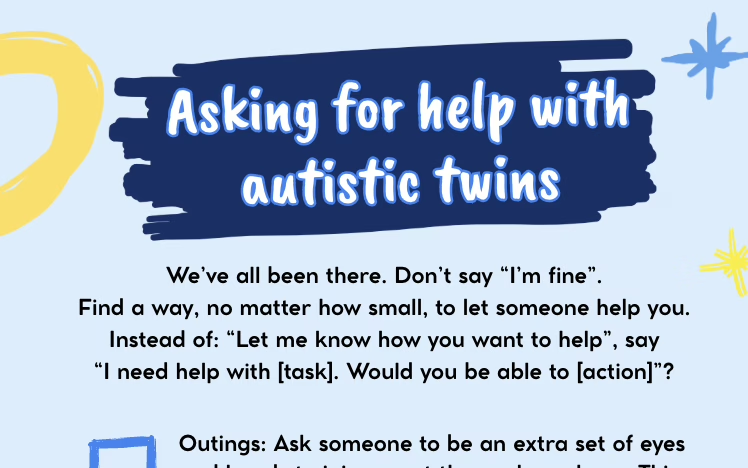
This mindset, however, creates a cycle of isolation. Leaving those who love you on the outside doesn’t just harm you; it prevents them from showing up for you in a meaningful way. People want to help, but they often don’t know how. They may make vague offers of support, and when you say “we’re fine,” they respect your privacy. The key to breaking this cycle is to be the one who opens the door, gently and with clear intention. You must take the first step in inviting them into your world. Print out the Asking for Help freebie and put it on your refrigerator so you can start asking for help today.
Open the door to making your needs known
When you’re ready to start asking for help, specificity is your greatest tool. Don’t say, “Let me know if you want to help.” That puts the burden of coming up with a solution on the other person. Instead, say, “I need help,” and then, offer concrete, easy-to-understand ways they can assist. This approach is disarming and effective because it gives a clear path forward for someone who genuinely wants to lend a hand.
Begin with requests that are manageable and low-risk. Instead of asking someone to babysit your twins for a full day, ask if they can bring over dinner one night. This small, thoughtful act can be a huge relief on a busy evening. Or, ask a friend to accompany you on a trip to the grocery store so you have another pair of eyes to watch the triplets. This builds confidence for both you and your helper and allows them to see firsthand the reality of your day-to-day life without the pressure of a full-fledged caregiving role.
When someone offers to help, take a deep breath and accept their offer. A simple, “Yes, that would be a huge help. Thank you so much,” is all that’s needed. If you can provide a simple, brief explanation of the situation, it can make all the difference. You don’t need to give a lecture on autism, but a quick sentence about a specific need can empower them to help correctly and confidently. For instance, “Leo has a hard time with loud noises, so we keep a pair of headphones on him when we go to the grocery store. Could you keep an eye on him for a few minutes while I run to the bread aisle?” This not only informs them but also educates them and empowers them to be a better support for you.
For family members or close friends who want to spend more time with your children, consider creating a simple, one-page guide (or modify our guide!). Include key information like their favorite calming activities, a list of their non-preferred foods, and what to do if they get overstimulated. This simple act can give your loved ones the confidence to engage with your twins in a way that respects their boundaries and supports their well-being. It transforms their well-meaning intentions into effective, helpful actions.
Embrace the “village” mindset, and remember that not everyone is equipped for the same task, and that’s okay. Your village can include different people for different needs. Maybe your friend is great for a coffee chat and emotional support, while your sister is the perfect person to help with laundry or meal prep. Your neighbor might be available to play with the kids in the yard for 20 minutes so you can make a phone call. Every person has something valuable to contribute. Learning to delegate to the right person for the right task is a crucial skill for your own well-being.
The gift of asking
Asking for help is not a one-way street; it is a gift you give to others. You are giving them the opportunity to show their love and support in a tangible way. It can be a powerful experience for them to see your multiples thrive and to be a part of their journey. They may not fully understand the complexities of autism, but by inviting them in, you are giving them the chance to learn and to be a part of a community that is deeply meaningful.
The road of parenting autistic multiples is a marathon, not a sprint. You don’t have to run it alone. The expectation to do it all is a myth that only leads to burnout and isolation. By communicating your needs with clarity and empathy, you can build a strong, supportive village around your family, ensuring that you have the support you need to not just survive, but to truly thrive. Using the checklist is a great place to start.
What’s the best way a friend or family member has helped you? Share your stories below.
Subscribe for the latest news and updates!
This website uses affiliate links. We may make a small commission from purchases when you use these links, at no additional cost to you. As an Amazon Associate we earn from qualifying purchases. We sometimes use AI to streamline content creation, allowing for the rapid production of high-quality content tailored for our audience.